Research 2
Where I started
I wanted to better understand the relationship between sonic properties and human emotion, and so I read through the following papers:
- Feeling the music: exploring emotional effects of auditory tactile musical experiences
- Musical emotions: psycho-physiological investigations
What I found
”Feeling the music”
The impact of a multisensory experience during music production is something that I want to hone in on, as I believe it directly impacts my applications ability to deliver on its ‘synesthetic’ approach to music production. In the first source I explored, I found supporting evidence that visual and tactile feedback affects human emotions, with the source stating that it “enhances upregulation of positive emotions and downregulates anxiety”.
I plan to provide example sounds or projects which will be used to demonstrate what sounds look like in my application. This will set the stage for the user’s creativity to run free. Although some users may naturally understand why some of the shape’s properties would be linked to the sonic properties that they are, others will not have any preconceived understanding or standard for the relationship between audio and visual. Having an array of examples will massively help in communicating the mappings of the transfer function used, without overwhelming the user with technical details.
I think that the idea of using examples will help me stay close to my original idea of simplifying the sound creation process by removing obscuring terms (at least on the surface), and will allow users to free themselves of thinking about music theory and technicalities, and focus on expression and experimentation.
”Musical emotions”
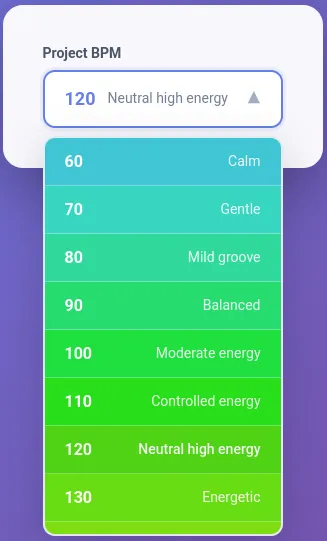
Before now, I hadn’t considered innate Tempo as a vital part of the synesthetic system that I’m aiming to build, and I have now understood that I was overlooking a very key part of what gives music its ‘feeling’. Tempo immediately strikes the listener, and is (far more often than not) consistent for the duration of the song. It sets the overall tone, and is something that is carefully chosen as part of the music production process. Each range of BPM gives a different feeling, and it is important that those feelings are reflected in my application. “Musical emotions: psycho-physiological investigations” helped me understand the impact of music and BPM on heart rate and emotions, and so I compiled a list of BPMs and their associated moods.
- 60 - Calm
- 70 - Gentle
- 80 - Mild groove
- 90 - Balanced
- 100 - Moderate energy
- 110 - Controlled energy
- 120 - Neutral high energy
- 130 - Energetic
- 140 - Very energetic
- 150 - Intense
- 160 - Extreme energy
- 170 - Hyperactive
- 180 - Peak energy
I will likely have these reflected in the BPM selection dropdown, with a similar feel to this mockup generated by Claude Sonnet 4.5: